Signs and Symptoms of HSV (Herpes Simplex Virus)
 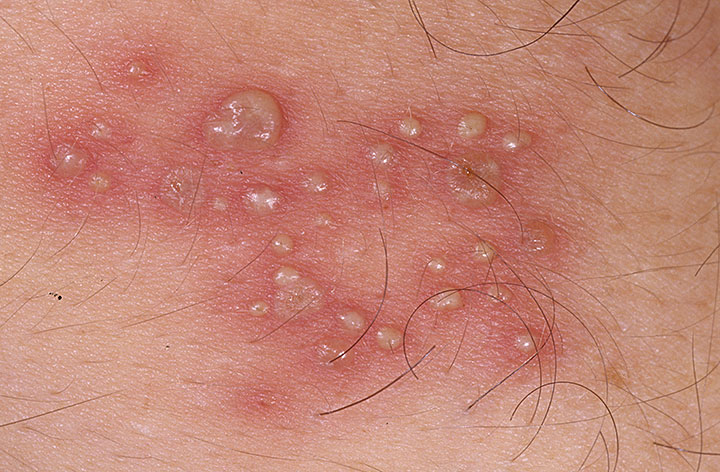 | The majority of people who've been infected with HSV never know they have the disease, because they have no signs or symptoms. The signs and symptoms of HSV can be so mild that they go unnoticed. When present, the initial symptom of genital herpes usually is pain or itching, beginning within a few weeks after exposure to an infected sexual partner. After several days, small red bumps or tiny white blisters may appear. They then rupture, becoming ulcers that ooze or bleed. Eventually, scabs form and the ulcers heal. In women, sores can erupt in the vaginal area, external genitals, buttocks, anus or cervix. In men, sores can appear on the penis, scrotum, buttocks, anus or thighs or inside the urethra, the channel inside the penis leading to the bladder. While you have ulcers, it may be painful to urinate. You may also experience pain and tenderness in your genital area until the infection clears. During an initial outbreak, you may have flu-like signs and symptoms, such as headache, muscle aches and fever, as well as swollen lymph nodes in your groin. |
Preventing HSV -
For a person without genital herpes, there are things you can do to protect yourself. These prevention strategies include:
Abstain from sex
Be faithful
Use condoms
Understand birth control options.
Don't Have Sex
Like other STDs, genital herpes is mostly spread through unprotected sex. Therefore, the best method of genital herpes prevention is to abstain from sex. This means not having vaginal, oral, or anal sex.
There is no cure for genital herpes. However, changing your lifestyle and some behaviors can lower your risk of contracting the virus or spreading the virus to others.
Lower Your Risk of Contracting or Spreading Genital Herpes
1. Change your sexual practices.
2. Change your habits.
3. Communicate with your partner.
4. Be informed.
5. Prevent spreading.
Change Your Sexual Practices
Abstain or refrain from sex.
This is the most certain way to avoid contracting genital herpes.
Have a long-term mutually monogamous (only one exclusive sexual partner) with someone who does not have genital herpes.
If you are infected, do not have sexual contact with anyone when you have an outbreak.
Always use a condom whenever you have sex.
It is important to know that the virus can be found on the skin in areas that are not covered by a condom, so even with protection, there is still some chance you can spread the virus to others.
Change Your Habits
Don't kiss other people when you have a cold sore (a blister due to HSV-1 found around your mouth).
Don't have oral sex when you have a cold sore.
An increasing number of genital herpes cases are caused by HSV-1.
Communicate With Your Partner
Talk and work with your partner to avoid contracting and spreading the virus.
Be Informed
Medications that prevent pregnancies, such as birth control pills, hormonal shots, spermicides, IUDs, and diaphragms do not protect you against sexually transmitted diseases.
Recognize when you are most contagious.
Know that you can spread the virus even if you do not have any visible sores or are not experiencing an outbreak.
Prevent Spreading
Don't touch any visible sores or blisters.
Wash your hands thoroughly with soap and warm water if you do touch a sore or blister.
Wash your hands frequently during the day even if you haven't touched a sore to prevent unintentionally spreading the virus
Make sure not to spread the virus to other parts of your body, such as your mouth or your eyes by touching sores and then touching these uninfected areas.
Take medications, such as valacyclovir, that are approved by the FDA for use in preventing the spread of genital herpes.
You should know that taking valacyclovir only reduces the risk of transmission by 50%.
A better way to protect you and your partner is to take valacyclovir and use a condom.
Treatment -
DRUGS
· Treatment with antiviral drugs can help people who are bothered by genital herpes outbreaks stay symptom-free longer. These drugs can also reduce the severity and duration of symptoms when they do flare up. Drug therapy is not a cure, but it can make living with the condition easier.
· There are three major drugs commonly used to treat genital herpes symptoms: acyclovir (Zovirax), famciclovir (Famvir), and valacyclovir (Valtrex). These are all taken in pill form. Severe cases may be treated with the intravenous (IV) drug acyclovir.
HERBS AND SUPPLEMENTS
· Many people say that an extract of the echinacea plant helps boost the immune system's ability to fight the genital herpes infection. Some say it decreases the frequency and severity of genital herpes outbreaks. Researchers in the U.K. compared the effect of echinacea with that of a placebo. They gave echinacea to 50 people with genital herpes for six months and a placebo for another six months. There was no significant difference in the number of herpes outbreaks during the two periods.
· Another study showed that an ointment containing propolis, a waxy substance that honeybees make, may help genital herpes sores heal. Sores healed faster for people using the propolis ointment than in those using ointments containing the antiviral drug acyclovir or a placebo. The ointment was applied to herpes sores four times a day. After 10 days, 24 of the 30 people using propolis ointment said their sores healed, compared with 14 of the 30 people using acyclovir ointment and 12 of the 30 using a placebo.
· Researchers have also found that the herb Prunella vulgaris, and an edible mushroom, Rozites caperata (the "gypsy mushroom"), contain chemicals that fight both the oral herpes virus (HSV-1) and the genital herpes virus (HSV-2).
· These treatments have not been approved for treating genital herpes by the FDA. You can buy them in stores, but they are considered nutritional supplements, not drugs, so they are not subjected to the same quality standards that FDA-approved drugs are.
THINGS YOU CAN DO FOR YOURSELF
First, simple self-care may be enough to relieve most discomfort caused by genital herpes. Taking an over-the-counter pain reliever, such as aspirin, acetaminophen, oribuprofen, can help ease the pain of herpes symptoms. Doctors sometimes recommend soaking the affected area in warm water. But the area should be kept dry most of the time. If toweling off after bathing is uncomfortable, try using a hair dryer. Then put on cotton underwear. Cotton absorbs moisture better than synthetic fabric does.
